The Bauhaus and contemporary design : a direct lineage
Bauhaus contemporary design is an expression you don’t often hear. And yet the school of Weimar and then Dessau, active from 1919 to 1933, is probably the most cited reference in interior design today.
Its fourteen years of existence produced a method, a philosophy, a vision of objects that continues to inform designers in a direct way. Not as nostalgic inspiration. As a system of thought that still works.

The Bauhaus’s most well-known principle is also the most often misunderstood. “Form follows function” is not an invitation to empty minimalism. It’s an invitation to think form from use rather than from decoration.
A chair must allow comfortable sitting. A table must offer a stable, appropriate surface. These functional constraints direct design toward forms that are more precise, more pared-back, more durable.
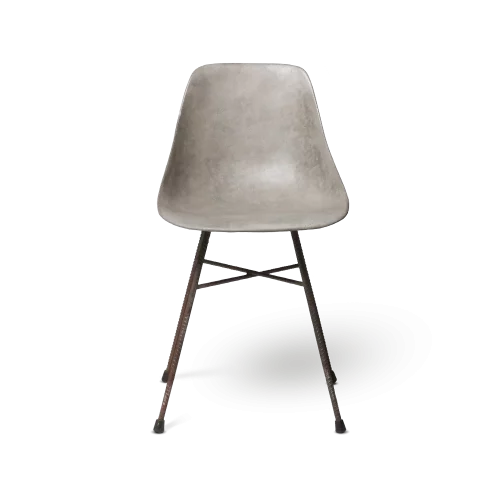
In Bauhaus contemporary design, this principle stays central. The most relevant pieces today are those that respond perfectly to their purpose without superfluous ornament. Lyon Béton’s Hauteville chair is a direct example : a fibre-reinforced concrete shell that follows the shape of the body, exposed rebar legs. Nothing hidden, everything justified.
The Bauhaus theorised what Le Corbusier was putting into practice in architecture : show materials as they are. Steel stays steel. Wood stays wood. No simulation, no veneer, no decoration to hide.
This stance is foundational to Bauhaus contemporary design. It explains why raw concrete, exposed metal, and solid wood are coming back so strongly in today’s interiors. These materials don’t pretend to be anything else. They own their nature.
Brutalist furniture extends exactly this tradition. The concrete is not coated, not tinted to look like stone or marble. It’s concrete, and it shows.

The Bauhaus school developed a visual vocabulary built on elementary forms : the square, the circle, the triangle. Forms everyone recognises. They transcend cultures and eras.
This geometric vocabulary is everywhere in Bauhaus contemporary design. The cubic volumes, the clean lines, the pared-back structures that dominate furniture today are directly inherited from it.
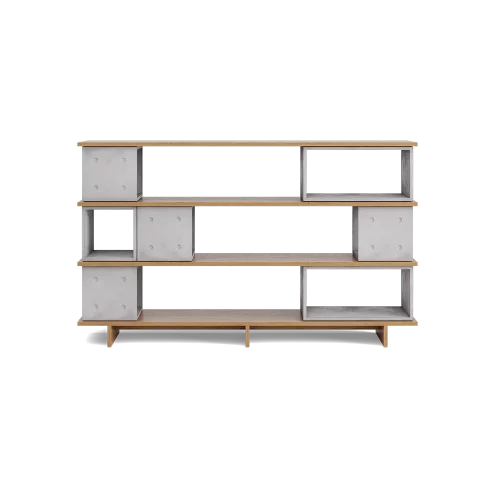
Alexandre Dubreuil’s Dice system illustrates this lineage. Concrete cubes, the simplest geometric form there is, stackable, combinable. The richness comes from combining simple forms, not from making them more complex.
One of the Bauhaus’s founding tensions was between craft and industry. The school sought to reconcile the two : create objects with the care and character of handmade pieces, but that could be produced in series and accessible to the greatest number.
This tension is very much present in Bauhaus contemporary design. Today’s design furniture brands navigate exactly between these two poles : careful manufacturing, often manual or semi-manual, for objects that keep a unique character while remaining reproducible.
That is exactly Lyon Béton’s logic. Each piece is hand-cast. Two pieces from the same mould will never be identical. The craft is in the process, even if the form is standardised.

The Bauhaus had a social ambition. Create well-designed, durable, accessible objects. Objects that don’t go out of style because they don’t follow styles. Objects that stand the test of time because they are built on principles rather than trends.
Bauhaus contemporary design carries this same ambition. In a context where over-consumption of furniture has become a serious environmental issue, the Bauhaus philosophy resonates differently. Buy less, but buy better. Pieces designed to last twenty, thirty, fifty years.
The fibre-reinforced concrete used by Lyon Béton fits exactly this logic. It’s a material of permanence, not of trend.

The Bauhaus today : not a style, a method
This is perhaps the most important distinction. The Bauhaus is not a style you can apply to an object. It’s a method of thought : start from function, choose materials for what they are, build forms that make sense.
When a designer today chooses to leave raw concrete visible, to not hide the rebar legs, to create simple, combinable geometric volumes, they are not drawing inspiration from the Bauhaus. They are continuing it.
For more on the history of the Bauhaus and its influence on contemporary design, the Bauhaus Dessau Foundation archives all of the school’s work.

What is the Bauhaus?
A school of art, craft and architecture founded in Germany in 1919 by Walter Gropius. Active until 1933, it profoundly influenced 20th-century design, architecture and the visual arts, and continues to inform contemporary design today.
What is the Bauhaus philosophy?
Combining form and function, showing materials as they are, using a universal geometric vocabulary, and reconciling craft with industrial production. In short : creating objects that are well-designed, honest, and built to last.
Is brutalism related to the Bauhaus?
Yes, directly. The brutalist architecture of the 1950s–70s extends several Bauhaus principles : material honesty, visible structure, the rejection of superfluous ornament.
Which contemporary designers draw on the Bauhaus?
Many. Among those who work with Lyon Béton, Alexandre Dubreuil and Bertrand Jayr share this philosophy : simple forms, raw materials, clear functionality.
How do you recognise a Bauhaus-inspired piece of furniture?
Pared-back geometric forms, honest and visible materials, no unnecessary ornament, visible functional logic. A Bauhaus piece says what it is and does what it should.
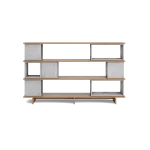
The products of the article