We noticed that you were on the American continent, would you like to be redirected to our US site?
HomeJournal Concrete shelf : what you need to know before buying
June 17, 2026
Concrete shelf : what you need to know before buying
Concrete design shelf : 5 essential things to know before buying | Lyon Béton
Concrete shelf : what you need to know before buying
A concrete design shelf isn’t bought like a wood or metal one. The material comes with its own constraints. Weight, fixings, finish, day-to-day use. These are all questions to answer before ordering.
This guide covers the 5 essential points for choosing the right concrete shelf and integrating it correctly into your space.
1. Concrete design shelf : weight, the first question to ask
Concrete is dense. A concrete wall shelf weighs between 5 and 25 kg depending on its dimensions and thickness. That’s considerably more than a wood shelf of the same size.
Two things follow from that. The wall fixing needs to be appropriate. Standard plugs in plasterboard aren’t enough. You need expansion plugs in concrete or brick, or chemical anchors for hollow walls. The load-bearing capacity of the shelf itself is also affected : a heavy shelf can carry less additional weight before reaching the limit of the fixing.
Before buying, always check the nature of your wall. Concrete, brick, plasterboard : the fixing solutions differ in each case.
2. Dimensions : length, depth, thickness
A concrete design shelf is also chosen according to its proportions. Concrete has its own structural rules.
Length. Beyond a certain length, an unreinforced concrete shelf risks deflecting under load. Fibre-reinforced concrete shelves can span further, but lengths over 120 cm generally require reinforcement or two fixing points.
Depth. A shelf of 20 to 30 cm suits most uses : books, decorative objects, plants. Beyond that, the weight of the shelf and the cantilever increase, which raises the demands on fixings.
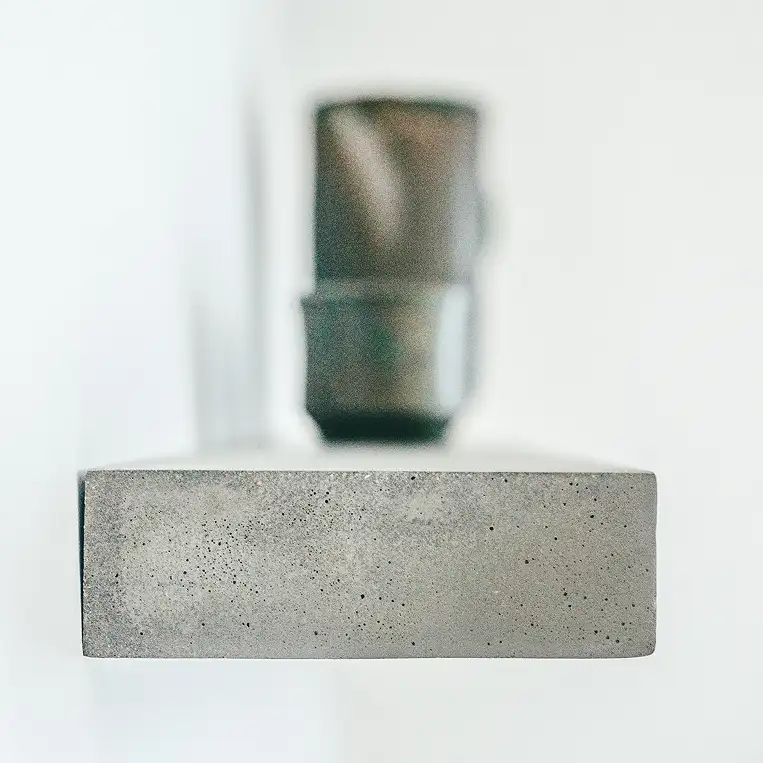
Thickness. It defines the visual character of the shelf as much as its resistance. A thin shelf (2-3 cm) gives a light effect, almost surprising for concrete. A thick shelf (5-8 cm) asserts the presence of the material.
3. The finish : raw, sanded or treated concrete
Not all concrete design shelves look alike. The surface finish completely changes the visual result and day-to-day maintenance.
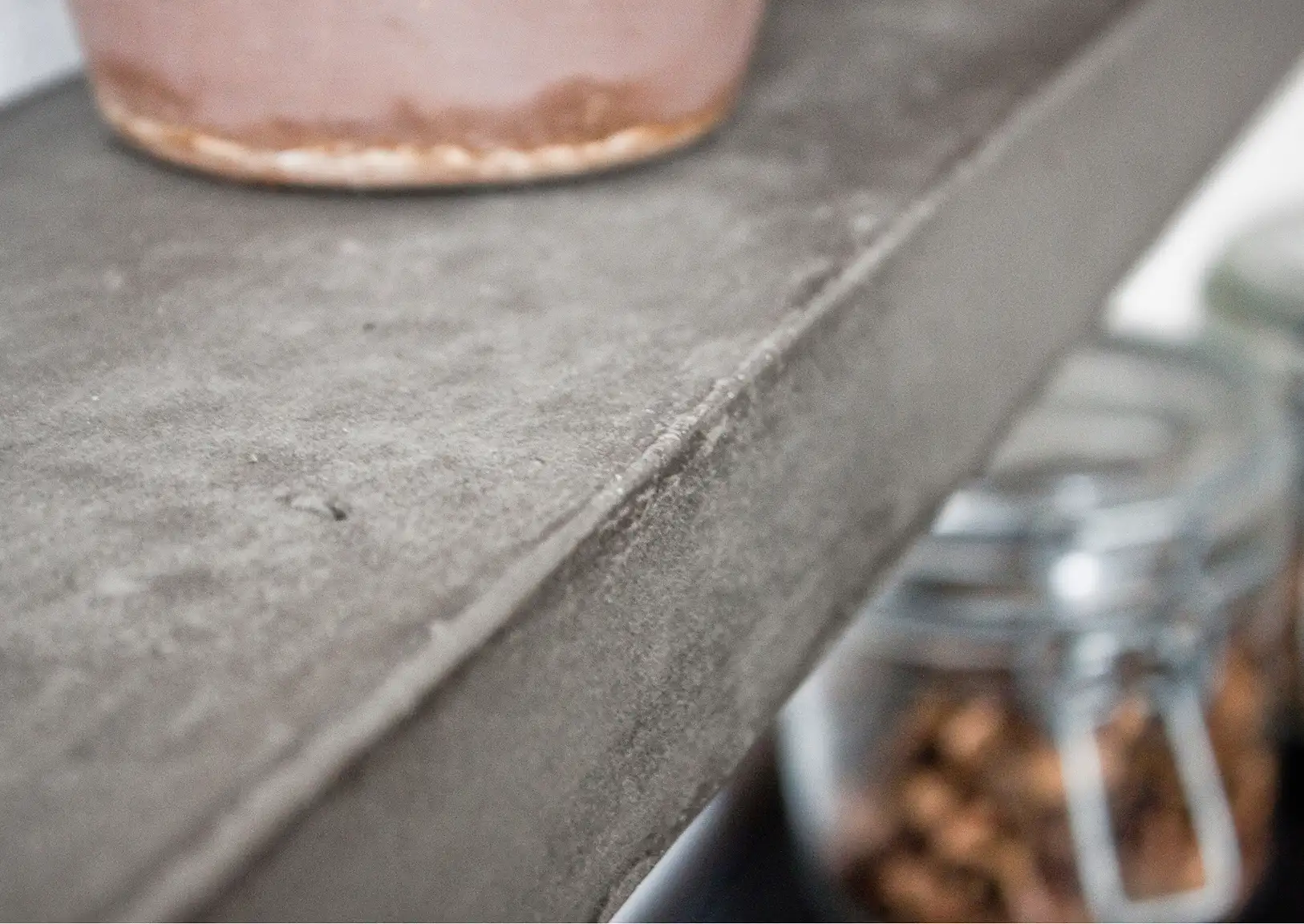
Raw concrete : the surface keeps the traces of casting, microbubbles, tone variations. It’s the strongest, most present character. It needs a waterproofing treatment to resist stains.
Sanded concrete : the surface is smoothed, more uniform, softer to the touch. It loses some of the raw character but gains in regularity. A good compromise for use in a kitchen or bathroom.
Tinted concrete : some manufacturers offer concrete shelves in colour. Black, white, terracotta. The colour is in the mass, not on the surface. It doesn’t chip.
The protective treatment is applied in-house at Lyon Béton on all pieces. As with all concrete furniture, occasional re-treatment with the Lithofin kit is enough to maintain protection over time.
4. Usage : bathroom, kitchen, living room, office
A concrete design shelf doesn’t go everywhere — or rather, it doesn’t need the same care depending on the room.
Living room and office : the simplest use. Little exposure to moisture, little risk of greasy stains. A basic treatment is enough.
Kitchen : exposure to grease and splashes. An oil-resistant treatment is essential. Prefer sanded concrete, easier to clean than heavily textured raw concrete.
Bathroom : permanent exposure to moisture. Choose waterproof-treated concrete, check that the manufacturer indicates suitability for bathroom use. Avoid areas of direct water splashing.
Covered outdoor use : possible for some concrete design shelves, provided they’re protected from direct weather and stored or covered out of season.
5. Concrete design shelf : integrating it into the space
A concrete shelf has a presence that few other materials have. It structures the wall it sits on.
Alone, it creates a strong anchor point. Placed above a desk or sofa, it frames the zone without weighing down the atmosphere.
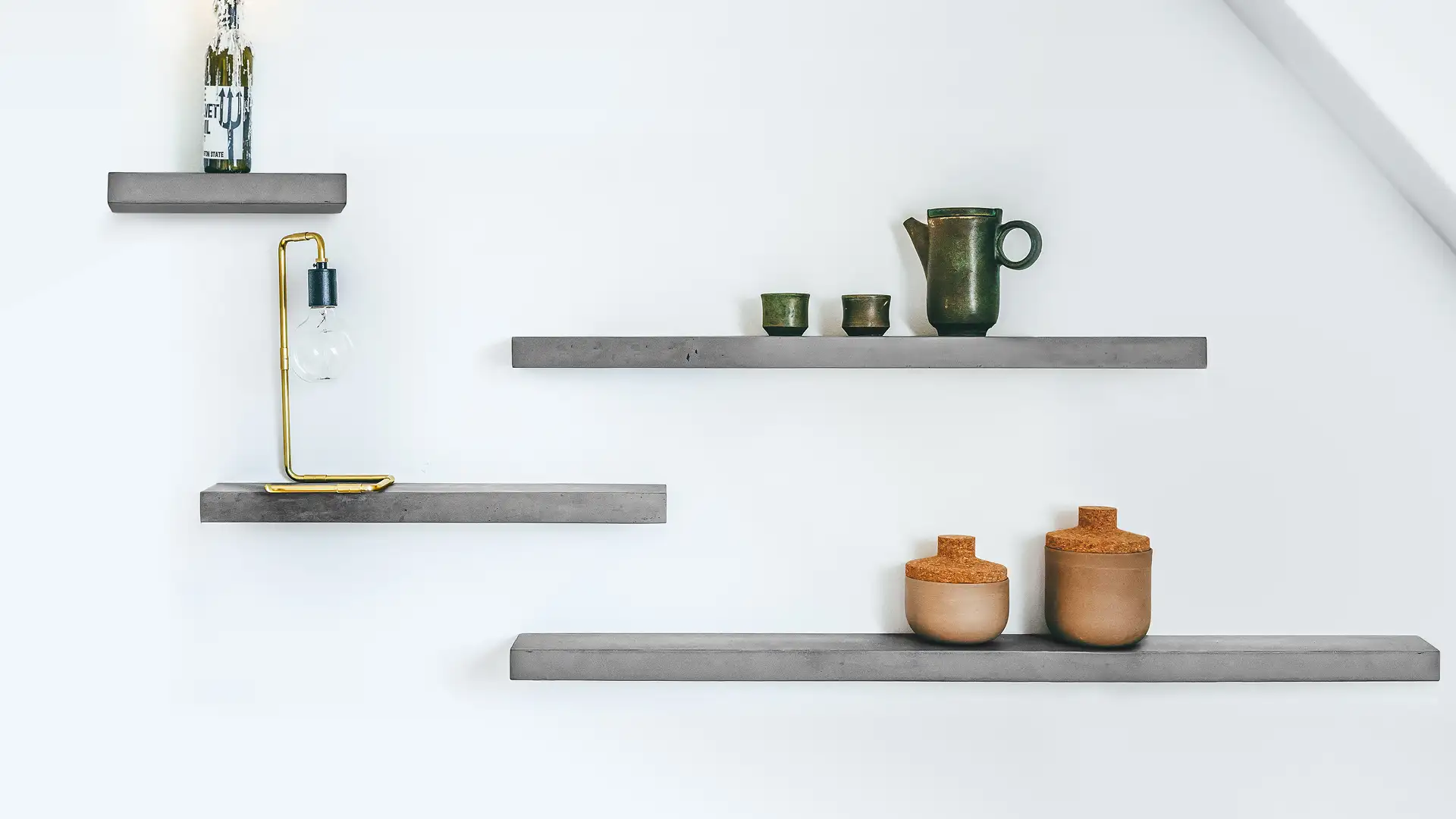
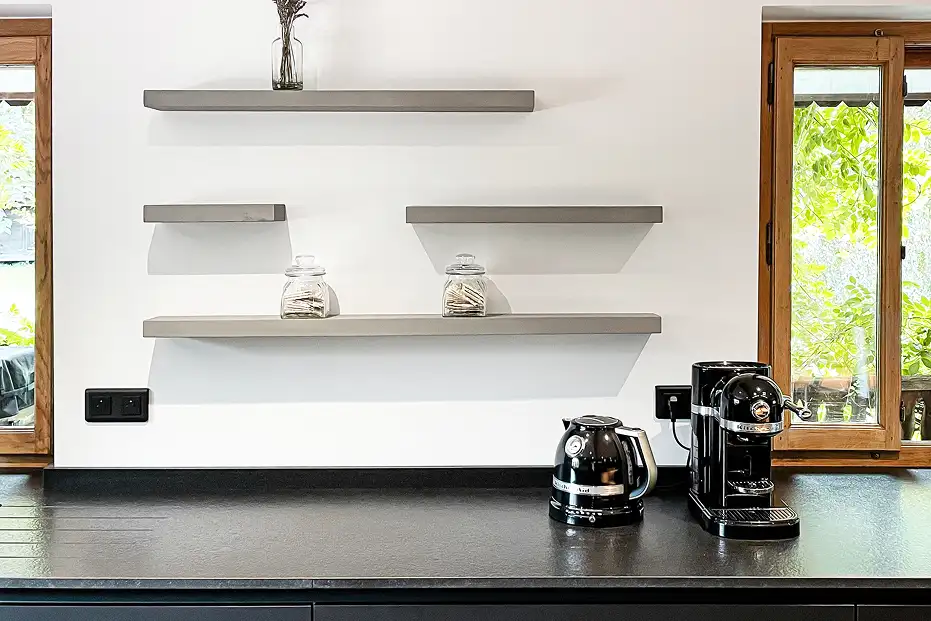
In a series, several concrete design shelves stacked in a staggered arrangement create an architectural composition. The space between the shelves is part of the design as much as the shelves themselves.
Paired with wood : concrete and wood work very well together as we explain in our article on concrete and wood pairing. A concrete shelf on wood battens or integrated into a wood-concrete storage system is one of the most successful combinations.
Bertrand Jayr’s Cloud pushes this idea in an unexpected direction : a cloud shape in concrete for an everyday domestic use. The object goes beyond simple storage function.
For more on the latest shelving design trends, Dezeen regularly documents the most interesting projects.
FAQ — Concrete design shelf
Can a concrete shelf be fixed to plasterboard?
Yes, but not with standard plugs. You need high-load-capacity plasterboard-specific anchors, or ideally fix into the metal studs of the frame. For the heaviest shelves, fixing into a load-bearing wall is preferable.
What load can a concrete shelf carry?
It depends mainly on the wall fixing. The fibre-reinforced concrete shelf itself is very resistant. It’s the fixing that defines the maximum load. As a general rule, plan for 15 to 20 kg of useful load for a shelf fixed into a load-bearing wall with two appropriate fixing points.
Does concrete stain easily on a shelf?
With the waterproof and oil-resistant treatment applied in-house, common stains wipe off easily. Without treatment or with a worn treatment, concrete absorbs liquids. Annual re-treatment is enough to maintain protection.
Can a concrete shelf be used in a bathroom?
Yes, provided the concrete is treated to resist moisture and the shelf isn’t exposed to direct water splashing. Prefer sanded and treated concrete over highly porous raw concrete.
What’s the difference between a fibre-reinforced concrete shelf and a standard concrete one?
Fibre-reinforced concrete integrates synthetic or glass fibres into its composition. It’s more resistant to impact and deflection, lighter, and allows thinner cross-sections. It’s the concrete Lyon Béton uses for its shelves and furniture.